No One, Number One: A campaign speech for DG-WHO
Opening statement
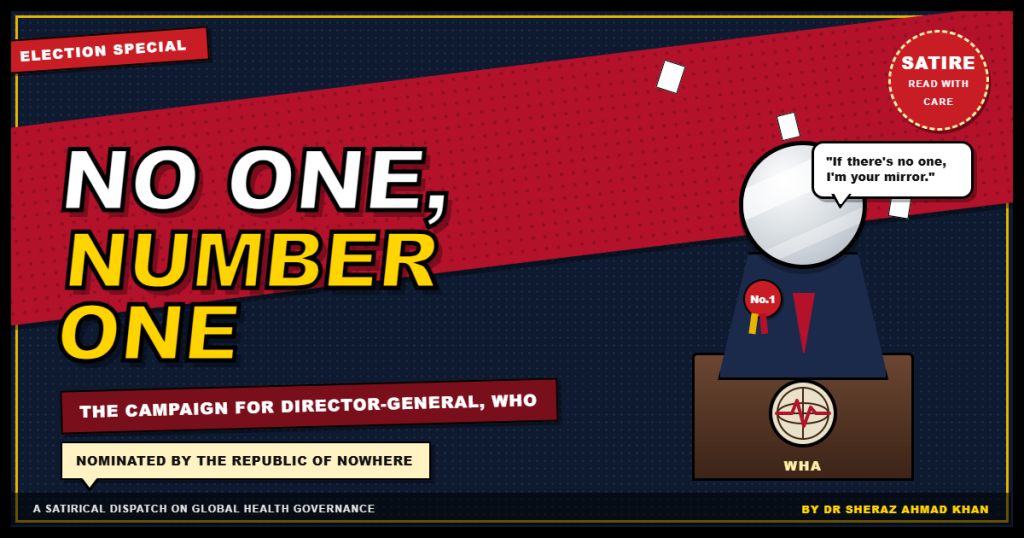
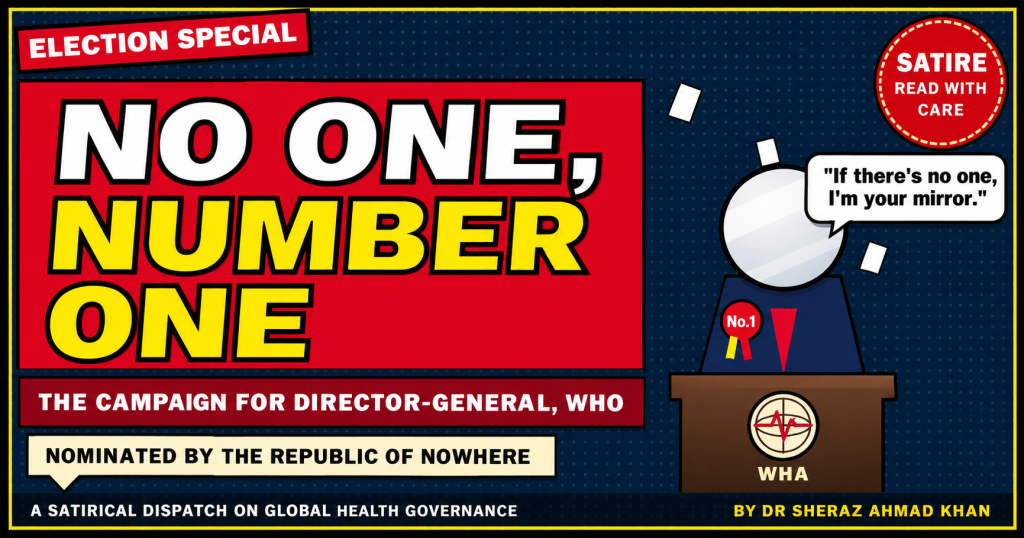
Hi. I am Mr No. 1, announcing my candidacy for the top job at the World Health Organization (WHO). If you read my name as “no one”, I am a mirror for you. If you read it as “number 1”, I am your echo chamber. The Republic of Nowhere is nominating me. I accepted their nomination for two reasons. First, it is difficult to find a true republic anywhere. And if a true republic existed, it might have enemies who would vote me down. Therefore, I am running from nowhere. I agree that I am not a candidate from a nation-state, but borders create arbitrary judgements. Running from nowhere should make me acceptable to both the Global North and the Global South. Please read carefully to understand why I am your best choice.
Relevant experience
Experience at WHO
I am pleased to confirm that I have never worked in, for, or with WHO. This is a rare inexperience to rely on. I am not part of any bloc or lobby within WHO. My soul is free from the inferiority complex of working in a country office, the identity crisis of working in a regional office, and the know-all attitude of the Geneva Headquarters’ insiders. I can spot inefficiencies, slash bureaucracy, and reclaim WHO’s legitimate place as the epicentre of global health.
Experience as a top bureaucrat
When his boss in the BBC’s Yes Minister Series thought five years was too slow in politics, Sir Humphry noted it was too fast and too dangerous for reforms. Bureaucracy is a talented breed, attuned to the unforeseen consequences of hypothetical problems that arise from proposed solutions to burning issues. In short, electing Sir Humphry and the like, who have made it to the top of the civil service, wouldn’t understand the value of time, timeliness, and the essence of “responsiveness” as the key objective of health systems.
I am neither a robot taking orders unquestioningly, nor Humphry, delaying reforms to the benefit of the status quo. As an outsider, I will not hallucinate like a large language model. Career bureaucrats have vast amounts of data, which poses similar problems to those of LLMs. As DG WHO, I swear to root out Whitehall’s secrecy, Berlin’s coldness, Washington’s bossiness, and the apologetic management style of the rest of the world. I do not carry outdated software the colonisers installed in the collective consciousness of bureaucracy in the Global South. Free of the colonial-legacy mindset and the subtle art of how not to reform, like the contemporary neocolonial archetype, I can take WHO off the ventilator. With no experience as a bureaucrat, my first instinct is an optimistic how rather than a pessimistic no.
Experience as a Health Minister
I have “not been” a long-serving health minister in the Republic of Nowhere. This unique privilege has kept me from mingling with the tobacco, pharma and food industries. I have considerable experience of being pure. Unlike many, I have the experience of “not flying” first class to medical conferences and owe nothing to any pharmaceutical company. I also have the unique experience of “not sitting” next to royalty at a Formula-1 race or Wimbledon. It is safe to say that I am a tobacco virgin. Since I am not a landlord, the food, seed and pesticides industry has never bothered me. Dear delegates, as you compare my experience with others’, do not discount my inexperience against others’ ill-experience.
Global citizen
I am a global health practitioner and a global citizen. Considering my global citizenship, many nation-states kindly offered to launch my candidacy, which I declined.
Nomination from the European Union (EU)
The EU Parliament invited me to speak on improving the global health architecture. I spoke and spoke and spoke. They liked it. I laid out a plan to promote global solidarity and equity that would protect the EU bubble against pandemics. Most of them, though not all, wanted to nominate me. Some representatives were on annual leave, while others looked to Paris and Berlin for a nod. Maybe the Germans had no objection, but their expressions were hard to read, and they were too tight-lipped to state their position explicitly. I thanked them for their interest, however, and withdrew from further consideration. Global solidarity and equity died at their hands because of vaccine nationalism. COVAX could only get jabs after EU citizens had their booster doses, and some had hoarded three times their national needs.
Nomination from the United States
The United States was happy to nominate me. I reminded them that, to nominate me, they had to be a WHO member state. They cited a provision of exceptionalism, claiming they were morally and politically entitled to nominate me. Nonetheless, I didn’t want to lose the Gulf States or all of Asia, as the “love-tap” in the Persian Gulf might be causing famine by the time their delegates descended on Geneva to vote at the World Health Assembly (WHA).
It was hard to decline their offer, so my global health diplomacy skills came in handy. I suggested they nominate their Secretary for Health and Human Services, a man who has spent a career telling Americans that vaccines are the greater danger, not the diseases they prevent. Having His Excellency as Director-General of WHO could help achieve its mandate, i.e., to attain and sustain the optimal state of health and wellbeing for all people. A mandate whose vaccine chapter he already doubts. No former DG had the wisdom to redefine illness as wellness and to close down WHO for good.
Nomination from Russia
The Russian Federation kindly made a similar offer. In addition, they offered me the Ukrainian Presidency. I couldn’t accept either. Their offers were generous but risky. First, they don’t get to decide who should lead Ukraine. Secondly, I do not want the African Union to boo me at the WHA. The war in Ukraine has disrupted their food supply chain, and I do not want to be the scapegoat. Besides, I cannot promote health and wellbeing with Sputnik alone. I will need contemporary mRNA-based technological solutions, which will evaporate if I accept the Kremlin’s offer. Moscow reminded me that a DG owes no one an apology for staying neutral. I agreed and said neutrality is not a favour I extend to one side. It is the only currency that lets a WHO convoy cross a front line at all, in Ukraine, Gaza, Sudan, or wherever the next line gets drawn. WHO’s own tally of attacks on hospitals and health workers does not ask which flag fired first, and neither will I.
Nomination by the Gulf Cooperation Council (GCC)
The GCC unanimously nominated me, provided the WHA agreed to elect me unanimously. I told the Royals that the WHA is a messy place where people dare to speak. I said it’s a one-nation, one-vote system. Democratic processes can be rigged through nations’ union in the United Nations. But it remains a democratic process. It turned out they feared democracy more than a pandemic and asked me for an alternative nominee. I humbly suggested that someone with a big yacht or a private jet might help carry some voters to the voting booth. We all know petrol prices are rising, and many voters from the Global South may not show up at the election. A Gulfstream can improve voter turnout.
Nomination by the African Union
The African Union offered the most sincere nomination. But I made it clear that the DG WHO cannot secure reparations for historical mistreatment or decolonise global health in a single term. Besides, if they point fingers at their former colonisers for delegitimising their traditional medicine, they may lose access to contemporary medicine and its wonders too.
Nomination by the East
I couldn’t accept a nomination from China or Japan because neither offered one. China did not want a player in the race. They thought a ceremonial role at WHO might create unnecessary trade friction that would affect export volumes. Instead, Beijing offered something more useful than a vote: a bigger cheque, arriving exactly as Washington’s stopped. I declined that too. An institution that swaps one dominant paymaster for another has not reformed its financing. The WHA’s own plan to raise assessed contributions towards half the budget exists precisely so that no single capital, old or new, can quietly become the field on which the rest of us play.
Japan, like China, wanted to work with anyone and remain a passive participant in the WHO elections, preferring to fund the technical work quietly rather than fight for the microphone. I did not cite the Lancet Editorial from our dear friend, i.e., Shinzo Abe. Mr Abe once affirmed Japan’s willingness to reform the WHO and the World Bank. As Prime Minister of Japan, he stood for universal health coverage and human security. Human security is important, but not as much as a permanent seat on the Security Council. Still, of everyone who did not nominate me, Tokyo came closest to naming the real reform: fund the mandate, not the moment.
Dear readers
I know quite a lot about big Pharma, big food, and big tobacco. Trust me, I have a plan to tackle them as your DG. But sorry, I cannot give you any further details. Otherwise, they will talk to someone who will talk to their WHA delegates to vote me down. What I can give you is the shortlist any candidate should be measured against, mine included.
1. Solidarity: If your country hoarded doses during the COVID-19 pandemic, do not lecture the Republic of Nowhere on what solidarity means. WHO exists so that the next pandemic is met with a shared plan, not a shared blame.
2. Equity: A mandate is not fulfilled by guidance issued from Geneva. Guidance should be paired with measures to create equitable conditions for implementation. Equity means financing, technology transfer, and manufacturing capacity that remain in the country once the emergency press conference ends. The mRNA hub in Cape Town should be the rule, not the exception wheeled out for a summit photo.
3. Responsiveness: Five years is too slow, as Sir Humphry’s boss complained, but so is five months when a variant will not wait for the next governing-board session. The DG’s job is to shorten the gap between a signal and a decision, not to protect the office diary.
4. The Right to exist: WHO is worth defending precisely because it is the one table where the Republic of Nowhere and the republics of everywhere sit as equals, one nation, one vote. Weaken that table and delegates do not get a better one; they get bilateral deals struck by whoever owns the private jet. But a seat at the table is not the same as a right to keep it, and legitimacy is earned by finishing what the table starts.
Take the Pathogen Access and Benefit Sharing annex to the Pandemic Agreement, WHA78.1. Member States are now in their eighth round of talks since May 2025, having already extended the deadline twice. They are still arguing over who supplies the pathogen sample and who receives the vaccine dose it buys. Or take the Global Code of Practice on the International Recruitment of Health Personnel, WHA63.16. At sixteen, it was amended again this May (2026) to cover care workers and health emergencies. Still, by design, it is a voluntary international code that a Ministry of Health can read and ignore that afternoon.
An institution can survive being slow. It cannot survive indecision disguised as consultation, year after year. Pathogens and nurses keep moving faster than the text under consultation. If WHO fails to meet the task, it has no inherent right to exist.
So read my name once more. If I am no one, I owe no capital a favour. This may be the only qualification this job has ever required. If I am number one, it is only because I am the echo chamber you built and then asked me to fix. Hold the mirror up to your own delegation before you vote. Choose whichever reading of my name you can live with in the next pandemic, not this one.
About the author
This satire is written by Dr Sheraz Ahmad Khan. Dr Khan holds a PhD in Global Health from the University of Edinburgh, an MPH, and an MBBS.
He is an Associate Professor of Global Health and writes on global health governance in his personal capacity.
Blog Posts